Prototype Series FAQs
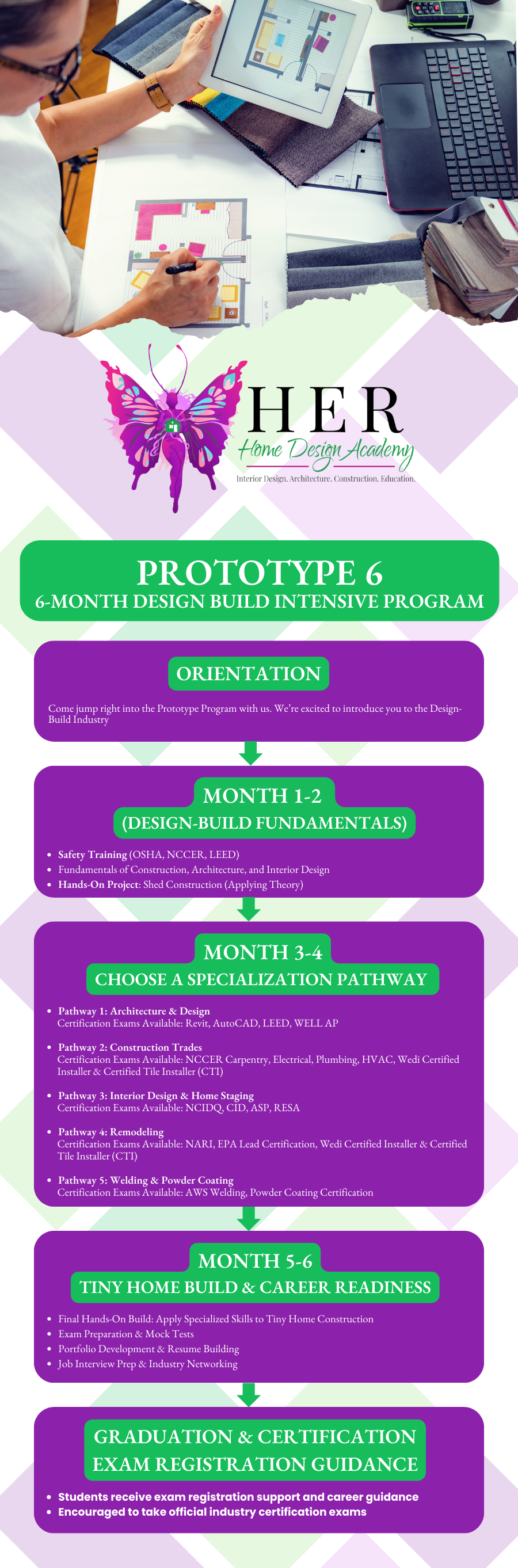
1. How is the Prototype 6 program different than the Prototype 10 Program?
The Prototype 6 Program is a 6-month course designed for adult women, focusing on Design-Build intensive learning in architecture, interior design, construction trades, and remodeling. It offers a condensed curriculum compared to the Prototype 10 Program, which is a 10-month Design-Build intensive course aimed at high school students, providing more extensive foundational learning and specialization opportunities.
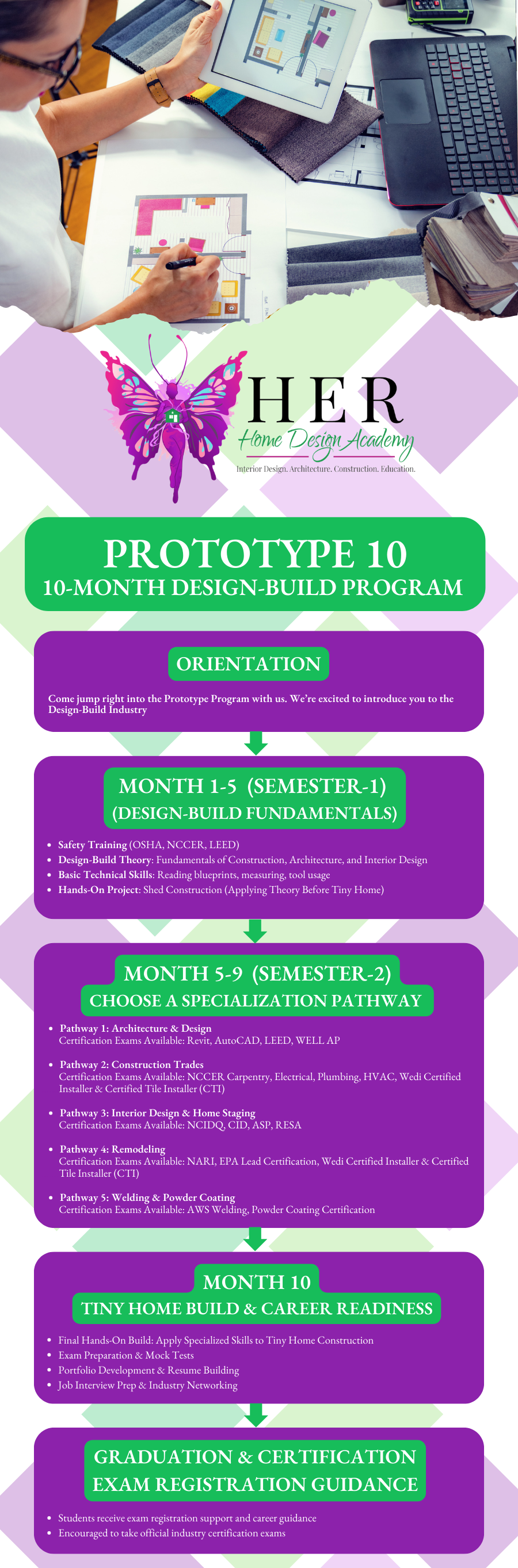
2. What is the structure of the 10-Month Design-Build Program?
The program is divided into two semesters:
Semester 1 (Months 1-5): Focuses on Design-Build Fundamentals & Hands-On Application.
Semester 2 (Months 6-9): Allows students to choose a Specialization Pathway.
3. What topics are covered in Semester 1?
Safety Training: Includes OSHA, NCCER, and LEED certifications.
Design-Build Theory: Fundamentals of Architecture, Interior Design Construction Trades and Remodeling.
Basic Technical Skills: Reading blueprints, measuring, and tool usage.
Hands-On Project: Shed Construction to apply theory before moving to Tiny Home Construction.
4. What are the Specialization Pathways in Semester 2?
Pathway 1: Architecture & Design
Certification Exam Prep: Revit, AutoCAD, LEED, WELL AP
Pathway 2: Construction Trades
Certification Exam Prep: NCCER Carpentry, Electrical, Plumbing, HVAC, wedi Certified Installer, etc.
Pathway 3: Interior Design & Home Staging
Certification Exam Prep: NCIDQ, CID, ASP, RESA Pro, Certified Staging Professional, Certified Home Stager.
Pathway 4: Remodeling
Certification Exam Prep: NARI, EPA Lead Certification, wedi Certified Installer, etc.
Pathway 5: Welding & Powder Coating
Certification Exam Prep: AWS Welding, Powder Coating Certification.
5. What happens at the end of the program?
Tiny Home Build: Students apply specialized skills to construct a Tiny Home.
Career Readiness: Includes certification exam prep, mock tests, portfolio development, resume building, job interview preparation, and industry networking.
Graduation & Certification Exam Registration Guidance:
Students receive support for exam registration and career guidance.
Encouragement to take official industry certification exams.
6. What is the overall goal of the 10-month program?
The program aims to provide deeper foundational learning in the first semester, followed by specialization and certification exam preparation in the second semester, concluding with the Tiny Home Build and career preparation.
7. What certifications can I receive through the program?
The program prepares students for various industry-recognized certifications, depending on the chosen specialization pathway:
Architecture & Design: Revit, AutoCAD, LEED, WELL AP.
Construction Trades: NCCER* Carpentry, Electrical, Plumbing, HVAC, wedi Certified Installer, ACCE*
Interior Design & Home Staging: NCIDQ, CID, ASP, RESA.
Remodeling: NARI, EPA Lead Certification, wedi Certified Installer, ACCE*
Welding & Powder Coating: AWS Welding, Powder Coating Certification.
Working with HER Home Design Academy
- Design & Construction Division -
1. Are students doing the construction work?
No. All construction work is completed by licensed and insured professional subcontractors. Students participate only in approved, supervised educational activities such as observation, documentation, and learning support.
2. Who do clients contract with?
Clients contract directly with HER Home Design Academy, a 501(c)(3) nonprofit. Design and construction services are provided through the Academy’s Design & Construction Division.
3. What types of projects does the Academy take on?
The Design & Construction Division focuses on residential projects under $100,000, including renovations, updates, and small-scale construction projects that align with our educational model.
4. Why operate design and construction inside a nonprofit?
Integrating professional projects into the Academy allows earned revenue to directly support education and workforce development, while maintaining strong governance, transparency, and accountability.
5. Does this affect quality or timelines?
No. Projects are delivered using professional project management, defined scopes, and experienced trade partners. Educational participation is structured so it does not disrupt quality or schedules.
6. How does this benefit the community?
Clients receive high-quality work, students gain real-world exposure, and project revenue is reinvested into training programs that strengthen the local design and construction workforce.